
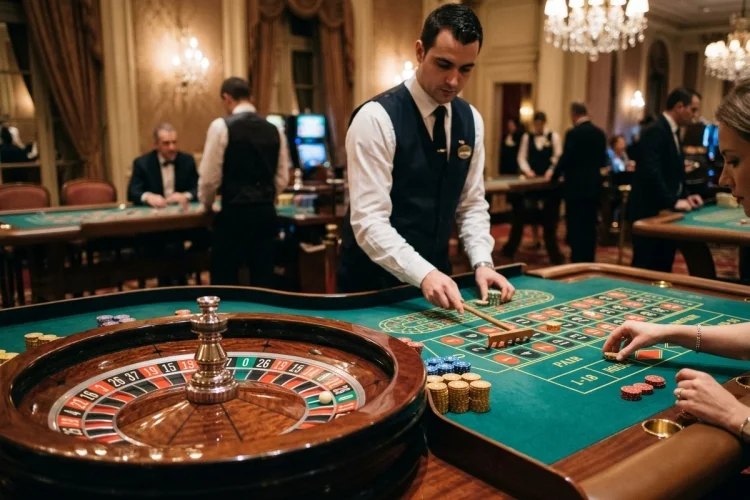
Roulette looks simple at first: place chips on the table, watch the wheel spin, and see where the ball lands. French Roulette follows that familiar formula, but a couple of special rules can significantly change what happens when the ball stops on zero.
So, What Is French Roulette? It is a single-zero version of roulette closely related to European Roulette. Its best-known features are La Partage and, at some tables, En Prison.
These rules apply to certain even-money wagers and make the French version mathematically different from many other roulette tables.
What Is French Roulette?
French Roulette uses a wheel containing 37 pockets. Numbers 1 through 36 alternate between red and black, while the single zero is traditionally green.
The wheel itself is essentially the same single-zero structure associated with European Roulette. French Roulette becomes distinctive through its table presentation, French betting terminology, and special zero rules.
A traditional French table may use labels such as Rouge and Noir instead of Red and Black, or Pair and Impair instead of Even and Odd.
According to Wizard of Odds, French Roulette uses a single-zero wheel and can include favorable half-back or En Prison rules on even-money wagers.
These special rules are the main reason the French version receives so much attention.
How the French Roulette Wheel Works
The wheel has 37 possible landing positions: zero plus the numbers 1 to 36.
Because there is only one zero, standard bets on a single-zero wheel generally carry a house edge of approximately 2.70%. This differs from American Roulette, which traditionally adds a second zero pocket.
The presence of zero matters because common outside bets such as red or black cover only 18 of the 37 pockets.
If you bet on red, there are 18 red numbers and 18 black numbers, but the green zero belongs to neither side. That extra outcome creates the casino’s mathematical advantage.
French Roulette modifies this situation on qualifying even-money wagers through La Partage or sometimes En Prison.
What Is the La Partage Rule?
La Partage is the most recognisable French Roulette rule.
The term roughly refers to dividing or sharing. If the ball lands on zero while you have an eligible even-money bet, only half of the stake is lost and the other half is returned.
For example, imagine placing $20 on red.
If the ball lands on a black number, the $20 loses normally. If it lands on red, the bet normally pays 1:1. But when zero appears under La Partage, $10 is returned and the remaining $10 is lost.
The rule generally applies to red/black, odd/even, and low/high wagers. Tom Horn Gaming’s French Roulette implementation specifically applies La Partage to those three even-money categories.
This reduces the effective house edge on qualifying wagers to approximately 1.35%.
How En Prison Works
En Prison provides another way of handling an even-money wager when zero appears.
Instead of immediately returning half of the stake, the qualifying wager can remain “imprisoned” for the following spin.
Under a common version of the rule, if the next result would normally win the imprisoned wager, the original stake is released rather than receiving a normal profit. If the following result loses, the imprisoned stake is lost.
Exact treatment can vary between tables, particularly if another zero appears.
That makes it especially important to read the individual game’s rules before placing a wager. French Roulette tables do not always offer both La Partage and En Prison, and implementation details can vary.
Casino.com’s French Roulette guide notes that these two rules are specifically associated with the treatment of even-money wagers when zero lands.
What Bets Can You Make?
French Roulette includes most familiar roulette wagers.
Inside bets focus on individual numbers or small groups of neighbouring numbers. A straight-up wager covers one number and traditionally pays 35:1, while splits, streets, corners, and six-line bets cover progressively larger groups.
Outside wagers cover broader sections of the table.
These include dozens, columns, red or black, odd or even, and low 1–18 or high 19–36.
La Partage does not normally reduce the house edge on straight-up numbers, splits, corners, dozens, or columns. Its main mathematical advantage applies to the three even-money categories.
That distinction is important because saying French Roulette has a 1.35% house edge without context can be misleding.
The reduced figure applies specifically when a qualifying half-back rule is active.
Why French Roulette Can Have a 1.35% House Edge
The mathematics are fairly simple.
Without La Partage, a standard single-zero roulette wager generally has a house edge of 1/37, or approximately 2.70%.
For an even-money bet, the player normally loses the full stake when zero appears.
La Partage changes that loss to half a stake.
Because the cost of the zero result is effectively cut in half, the long-term edge on those qualifying bets becomes approximately 1.35%. Both specialist roulette references and French Roulette game documentation report this figure.
That does not mean a player will lose exactly 1.35% in a short session. House edge describes a long-term mathematical expectation, not the outcome of individual spins.
French Roulette Table Terminology
The French-language table can initially look unfamilar even if you already understand European Roulette.
Rouge means red and Noir means black. Pair means even, while Impair means odd.
You may also see Manque for the lower half of the numbers, typically 1–18, and Passe for the upper half, 19–36.
French tables may use terms such as Douzaine for dozen wagers and Colonne for columns.
Fortunately, online versions often provide visual highlighting or English interface options, so learning every French term is not usually required before playing.
Still, understanding the main labels makes the traditonal table layout considerably easier to read.
What Are French Roulette Call Bets?
Another familiar feature of French-style Roulette is the racetrack betting area.
Rather than selecting numbers based on their position on the betting grid, racetrack wagers cover neighbouring sections of the physical roulette wheel.
Common names include Voisins du Zéro, Tiers du Cylindre, Orphelins, and Jeu Zéro.
These wagers are made from combinations of straight-up and split bets covering specific wheel sectors.
They are sometimes called announced or call bets, although online implementations usually allow them to be selected directly from a racetrack interface.
These bets do not automatically receive the La Partage advantage because they are not even-money outside bets.
French Roulette vs European Roulette
French and European Roulette share the same basic 37-pocket single-zero wheel.
The biggest difference is the special treatment of zero on qualifying wagers.
A standard European table without La Partage usually carries the normal 2.70% house edge on even-money wagers. A French table applying La Partage reduces that figure to around 1.35%.
The table appearance can also differ.
French Roulette commonly uses French terminology and may prominently display racetrack wagers, while European tables often use English-language labels.
However, online casinos can blur these distinctions. Some European-style tables may include special zero rules, while some games marketed as French Roulette may implement only La Partage rather than every traditonal French convention.
Always check the actual game information.
Why Game Rules Matter Online
An online French Roulette table should clearly explain whether La Partage, En Prison, or both are active.
This matters because simply seeing a single-zero wheel does not confirm that the French rules apply.
The UK Gambling Commission’s remote technical standards require applicable game rules and information about how customers can win to be easily available before gambling.
The rules page should also explain payouts and special features.
Before playing, check the information panel for zero rules, betting limits, table payouts, and whether announced bets are supported.
That is much more reliable than assuming every game labelled “French Roulette” works identically.
French Roulette combines the familiar single-zero roulette wheel with special rules such as La Partage and sometimes En Prison.
Its most notable mathematical difference appears on qualifying even-money bets, where La Partage can reduce the house edge to about 1.35%.
Before choosing a table, open the game rules and confirm exactly which zero rules, bet types, and payouts are available.