
Author: Gabriel Monteiro

Bonuses

Sticky Bonuses vs Non-Sticky Bonuses: What’s the Difference?

Casino bonuses can look almost identical on the promotion page. Two operators might both offer a 100% deposit match, yet the way those bonuses behave after you deposit can be completely different.

That is where Sticky Bonuses vs Non-Sticky Bonuses becomes important. A sticky bonus generally remains tied to your account and cannot itself be withdrawn, while a non-sticky structure usually keeps real-money funds and promotional funds more separate.

The exact rules vary between operators, so understanding balances, wagering requirements, and withdrawal conditions is more useful than judging an offer by its headline percentage.

What Is a Sticky Casino Bonus?

A sticky bonus is generally promotional credit that can be used for gambling but is not itself cashable.

BetMGM describes sticky bonuses as offers that have no cash value even though they can be used on eligible casino games.

Imagine depositing $100 and receiving a $100 sticky bonus.

Your displayed balance might become $200, but that does not necessarily mean you can eventually withdraw the full $200 plus any winnings. The promotional $100 may remain non-cashable and be removed when a withdrawal is processed.

PokerNews similarly defines a sticky bonus as bonus money that can be wagered but cannot itself be cashed out.

That non-withdrawable element is what makes the bonus “sticky.”

How Sticky Bonuses Affect Your Balance

Sticky offers can create a balance that looks larger than the amount of cash you actually own.

Suppose you deposit $50 and receive another $50 as promotional credit.

Your account might display $100 available for play.

However, if the bonus is non-cashable, part of that amount exists only to support gambling activity. Even after meeting applicable wagering requirements, the original promotional amount may be deducted before withdrawal.

Different operators structure this differently.

Some combine deposited cash and bonus funds into a single promotional balance. One current operator’s terms, for example, describes its sticky deposit bonus as combining deposit and bonus funds until its wagering conditions are completed.

This is why simply looking at the account total can be misleadng.

The terms determine which part is actually withdrawable.

What Is a Non-Sticky Bonus?

A non-sticky bonus generally gives players more separation between their own money and promotional funds.

A common setup uses the real-money balance first.

If you win while gambling only with your deposited cash, you may be able to withdraw that cash and its associated winnings by forfeiting or leaving the unused bonus behind, depending on the offer.

Only when the real-money balance is exhausted does the bonus balance become active.

BetMGM describes non-sticky bonuses as having a real-money element that players may be able to withdraw subject to the relevant offer conditions.

This structure is sometimes called a parachute bonus because the promotional credit effectively waits in reserve.

However, “non-sticky” is industry terminology rather than a guarantee of one universal set of rules.

Always check exactly which balance is used first.

A Simple Sticky vs Non-Sticky Example

Imagine two casinos both advertise:

Deposit $100 and receive a $100 bonus.

Casino A uses a sticky structure.

Your deposit and bonus may become closely linked, and you might have to complete the required play before making a withdrawal. Even afterward, the promotional $100 itself may not be cashable.

Casino B uses a non-sticky model.

Your $100 deposit may remain in a cash balance while the bonus sits seperately. If your cash grows to $160 before the bonus is touched, the terms might let you withdraw the cash winnings by cancelling the promotional bonus.

That distinction can be more important than the size of the bonus.

Both promotions advertise an extra $100, but the amount of flexibility available to the player is quite different.

Wagering Requirements Are a Separate Issue

Sticky and non-sticky describe how bonus and cash balances behave.

Wagering requirements describe how much qualifying gambling must occur before restricted funds or winnings become withdrawable.

Those concepts should not be confused.

A sticky bonus can carry wagering conditions. A non-sticky offer can also have wagering requirements once the bonus balance becomes active.

For operators licensed in Great Britain, wagering requirements on incentives have been capped at a maximum of 10 times since January 19, 2026.

For example, a £20 promotional bonus under that framework cannot require more than £200 of qualifying wagering.

Different countries can use completely different regulations, so this cap should not be applied globally.

Can You Withdraw Your Deposit During a Bonus?

This question is one of the easiest ways to understand the difference between bonus structures.

With a genuinely separate non-sticky arrangement, players may have greater ability to withdraw their remaining cash balance before using promotional funds, although cancelling the bonus may be required.

Sticky structures tend to provide less separation.

The UK Gambling Commission’s consumer guidance says gambling businesses should let customers walk away and retain what remains of their deposit along with winnings generated from play using that deposit.

Operators should also clearly distinguish the customer’s own money from restricted bonus funds.

That regulatory guidance is particularly relevant to British-licensed businesses.

Elsewhere, exact rules can vary substantially.

Never assume that clicking “withdraw” will have no effect on an active promotion.

Game Restrictions Can Change the Real Value

A bonus can look attractive until you discover that your preferred games barely contribute to its requirements.

Casino promotions can restrict which products are eligible.

Slots might count fully toward wagering while blackjack, roulette, or live dealer games contribute less or nothing at all.

Maximum bet restrictions may also apply while promotional funds are active.

The UK Gambling Commission defines significant promotion conditions as including issues such as qualification rules, maximum stake sizes, time limits, and wagering requirements.

ASA guidance likewise says deposit requirements, wagering conditions, eligibility restrictions, and time limits should be made clear in gambling promotions.

Those details often matter more than whether the banner simply says “sticky” or “non-sticky.”

Which Type Is More Flexible?

In general, a properly structured non-sticky bonus can provide more flexibility because cash and promotional funds remain more clearly separated.

That does not automatically make every non-sticky offer better.

A non-sticky bonus could have restrictive game rules, a short expiry period, or an unattractive wagering requirement.

Meanwhile, a sticky promotion could theoretically have relatively simple conditions.

The best comparison looks at the entire package: bonus amount, cashability, wagering multiple, game contribution, maximum stake, expiry period, and withdrawal rules.

There is no reason to accept a promotion simply because it appears large.

Sometimes playing without a bonus is simpler.

Sticky Bonuses vs Non-Sticky Bonuses mainly comes down to how promotional funds interact with your real-money balance. Sticky bonuses are generally non-cashable, while non-sticky structures usually provide more separation between cash and bonus funds.

Before opting in, check which balance is used first, what happens during withdrawal, and what wagering rules apply. Choose only promotions you clearly understand and that fit your existing entertainment budget.


Live Casino

What Is a Live Casino Bet Timer? How Betting Windows Work

Live casino tables move continuously. A roulette dealer prepares the wheel, baccarat cards wait to be dealt, and a countdown on the screen tells players they have only a limited period to place their wagers.

So, What Is a Live Casino Bet Timer? It is essentially a countdown showing how long the betting window remains open for a particular round.

When that period ends, new wagers are normally no longer accepted and the game moves toward determining the result. Understanding the timer helps players avoid missed bets and unnecessary last-second decisions.

What Does the Bet Timer Actually Do?

A live casino bet timer separates the wagering stage from the result stage.

At the beginning of a round, the system opens a betting window. Players can choose their stake and place eligible wagers while the countdown continues.

When time runs out, the platform closes betting.

The dealer can then proceed with the physical action, such as dealing baccarat cards or completing a roulette spin.

This separation is important because players should not be able to wait until the outcome becomes clear before deciding whether to participate.

The timer therefore provides a visible boundary between making a wager and discovering the result.

Why Live Casino Games Need a Countdown

Unlike ordinary digital casino games, live tables often serve many players simultaneously.

Everyone needs to participate in the same physical round.

Imagine a roulette dealer waiting individually for hundreds of remote users before every spin. The game would quickly become impractical.

A shared betting window solves that problem.

Players receive a defined period to arrange their bets, after which the dealer continues the game.

Betting times can be surprisingly short. Pragmatic Play has described its Speed Baccarat tables as using 12 seconds of betting time within a 27-second overall game round.

That is why understanding the interface before betting can be useful.

Betting Time Varies Between Games

There is no universal live casino timer.

Some games are intentionally fast, while others give players more time.

Pragmatic Play’s VIP Blackjack provides a useful comparison. The provider currently advertises a 20-second betting period on its VIP tables, compared with a stated normal betting time of 14 seconds. It also extends blackjack decision time from 10 to 20 seconds.

Its ONE Blackjack product lists a 16-second betting time.

These examples show why players should not assume the timer will feel identical after switching tables.

A fast baccarat game may demand much quicker input than a premium blackjack table designed around a slower atmosphere.

What Happens When the Timer Reaches Zero?

Once betting closes, the interface normally stops accepting new wagers for that round.

A roulette table might disable the betting layout while the ball approaches its final result. Baccarat can move immediately into dealing the cards.

Evolution’s Fan Tan provides another example. The provider explains that after betting time expires, the dealer reveals the selected beads and begins the process that determines the result.

If you fail to place a wager before the cut-off, the practical result is usually simple: you wait for the next round.

There is no need to chase the missed opportunity with a larger wager afterward.

Another round will normally follow.

The Timer Is Different From Blackjack Decision Time

A live blackjack table can contain more than one type of countdown.

First comes the betting timer, during which the initial wager is placed.

Later, players may receive a separate decision window for actions such as Hit, Stand, Double, or Split.

These timers perform different functions.

Missing the initial betting window can mean sitting out the hand. Missing a decision timer after entering the hand may trigger whatever default procedure the particular game uses.

Pragmatic Play’s VIP Blackjack specifically distinguishes its 20-second betting window from its 20-second decision period.

Always read the game’s instructions to see what occurs if no action is submitted.

The software should explain this rather than leaving players to gues.

Network Latency Can Affect Timing

A timer on your screen exists inside an online system, so internet performance matters.

The video arriving on your device may be slightly delayed compared with events occurring inside the studio. Your click also needs time to travel back to the gaming system.

The UK Gambling Commission specifically addresses this issue through its requirements for time-critical events. Operators must consider situations where network latency or slower device performance could disadvantage customers and provide appropriate information about that risk.

For players, the practical lesson is simple.

Do not deliberately wait until the final fraction of a second to submit an important wager.

Leaving a little extra time reduces the risk that a slow conection causes the betting window to close first.

Not Every Live Game Uses a Conventional Timer

An interesting exception is Evolution’s Instant Roulette.

Instead of giving everyone one shared countdown, the game uses 12 synchronised automated roulette wheels. Players receive unlimited betting time and click “Play Now” when ready, after which the system selects the wheel closest to producing its next result.

This shows that the countdown is a design choice rather than an unavoidable feature of every live game.

Traditional shared tables need clear betting windows because everyone participates in the same round.

Multi-wheel or player-controlled formats can use different technology to remove that pressure.

If short countdowns feel uncomfortable, looking for a slower or player-paced game can make more sense than trying to act faster.

Does a Longer Timer Improve Your Chances?

No.

Betting time controls when you can place a wager, not the underlying probability of winning it.

Twenty seconds to choose a roulette number does not make that number more likely to appear than if you had only ten seconds.

Likewise, a faster baccarat table does not become mathematically more favourable just because it produces more rounds.

In fact, faster games can allow more wagers to occur within the same amount of time.

That makes awareness of your spending particularly importent.

The timer should be treated as an interface feature, not as a signal that you need to make a decision before an opportunity somehow disappears.

A Simple Way to Use the Timer

The safest approach is to decide what you want to do before the countdown reaches its final seconds.

Choose the table because its rules and limits suit your budget. Once a round begins, place only the wager you already intended to make.

If you are still unsure when the timer is nearly finished, skipping the round is perfectly reasonable.

There is no mathematical penalty for waiting.

Live casino games are designed to continue round after round, and missing one does not make the next outcome better or worse.

This mindset can prevent rushed clicks and accidential stakes.

What Is a Live Casino Bet Timer? It is the countdown defining when players can submit wagers before a live round moves into its result phase.

Timer lengths differ between games, and internet latency can matter near the deadline.

Learn the interface before betting, avoid last-second wagers, and simply skip a round when you need more time rather than allowing a countdown to rush your decision.

Live Casino

What Does Table Limit Mean in Live Casino Games? A Simple Guide

Open a live casino lobby and you will usually see several versions of roulette, blackjack, or baccarat that appear almost identical. Yet one table may accept very small wagers while another expects considerably larger stakes.

So, What Does Table Limit Mean in Live Casino Games? A table limit defines the minimum and maximum amounts that can be wagered under the rules of a particular table.

Understanding these boundaries helps players choose a game that fits their budget and prevents surprises after joining. The concept is simple, although individual bet types can make the details slightly more complicated.

What Is a Table Limit?

A table limit establishes the permitted betting range at a casino table.

For example, a live roulette table might display a minimum wager of $1 and a maximum of $5,000. That tells players the general stake range accepted at that particular game.

Live casino software commonly makes this information available directly through the game interface. Playtech’s current help documentation, for example, says the minimum and maximum amounts for a specific live game can be viewed through its Table Limits control.

Table limits therefore help separate low-stake, standard, and high-limit versions of the same game.

They do not tell you whether a table offers better odds.

How the Minimum Table Limit Works

The minimum is the lowest qualifying wager allowed under the table’s rules.

Suppose a blackjack table has a $5 minimum. A player normally cannot start a standard hand with a $1 initial wager.

This is useful to know before joining because the minimum strongly affects how quickly a budget can be used.

Imagine having a $30 entertainment budget. At a $10-minimum table, just three losing initial wagers could consume that amount. A $1 table gives substantially more room to spread the same budget across rounds.

The important lesson is not that smaller stakes improve the odds. They simply reduce the amount placed at risk on an individual wager.

Choosing a suitable minumum is therefore mainly a budgeting decision.

How the Maximum Table Limit Works

The maximum establishes the other end of the range.

If a table has a $2,000 maximum, the operator will not normally accept a standard wager above the applicable limit.

Maximum limits help define how much financial exposure can be placed on a particular table or betting option. They can also vary significantly between ordinary and VIP environments.

Importantly, a displayed maximum may not apply identically to every possible wager.

Roulette is a good example. A table may have different maximums for straight-up numbers, splits, dozens, red or black, and other bet categories.

That means “maximum table bet” does not always mean you can place the entire displayed amount on any location you choose.

Always inspect the game’s detailed limits before assuming how the cap works.

Why Different Tables Have Different Limits

Casinos serve players with very different preferred stake sizes.

Someone may want to play blackjack for $1 per hand, while another customer may prefer wagering hundreds.

Providing multiple tables allows the operator to serve those groups without putting everyone into one betting range.

This explains why a live casino lobby might display several roulette tables that look nearly identical.

The studio, wheel, or basic rules may be similar, while the minimum and maximum stakes differ.

Some tables are deliberately marketed as high-limit or VIP options. Others are structured around smaller stakes and broader accessibility.

Gaming Laboratories International’s live-dealer standards have historically treated minimum and maximum wagers as important information that should be displayed to remote customers.

Checking this information before joining is easier than discovering an unsuitable limit after the stream has loaded.

Table Limits Can Differ by Bet Type

This is where beginners can become confused.

A roulette table might advertise a broad overall range, but individual betting positions can have their own restrictions.

A straight-up wager on one number exposes the casino to a different payout than a bet covering red or black. Operators can therefore structure maximums differently across those categories.

Blackjack creates another situation.

The main wager might have one minimum and maximum, while optional side bets follow a seperate range. Doubling or splitting can also increase the total amount committed during a hand.

Baccarat can use similar structures, especially where Player, Banker, Tie, Pair, or other side bets are offered.

The game information panel should be treated as the final authority rather than assuming one headline limit applies universally.

Table Limits Are Not Deposit or Account Limits

A table limit controls a wager at a particular gaming table. It should not be confused with financial controls applied to the player’s entire account.

Deposit limits, stake limits, and loss limits can operate at an account level or across products, depending on the operator and jurisdiction.

For example, UK Gambling Commission requirements provide customers with facilities to establish financial limits, while updated guidance also recognises stake and loss limits as separate types of controls operators can offer.

Consider someone with a personal account limit of $100.

A live table may technically allow a $500 wager, but the player’s own account restrictions can still prevent that amount from being placed.

The table maximum tells you what the game permits. It does not override stronger restrictions elsewhere.

Do Higher-Limit Tables Have Better Odds?

Not automatically.

A $500-minimum blackjack table is not inherently more likely to produce winning cards than a $5 table simply because more money is being wagered.

Likewise, increasing the roulette stake does not improve the probability that a chosen number appears.

Rules can differ between tables, however, so comparison is still useful.

One blackjack table could use different rules for dealer actions, doubling, splitting, or payouts. Those rules can affect the mathematical house advantage independently of the betting limit.

This distinction matters.

Choose a table based on both its rules and affordable stake range rather than treating a high limit as evidence of a better game.

Why Clear Stake Information Matters

Players should be able to see how much money they are risking before committing to a wager.

The UK Gambling Commission’s remote technical standards require applicable systems to show the financial commitment for a gamble and relevant information such as unit stake and total stake.

That is particularly helpful in live games because chips and betting areas can make several simultaneous wagers easy to place.

Before the betting timer expires, look at the total amount shown on screen.

If several roulette chips have been added, the combined stake can be much larger than one individual chip. Blackjack side bets can create the same issue.

The displayed total is more useful than mentally estimating your exposure.

How to Choose a Suitable Table Limit

Start with your intended session budget rather than the highest amount the casino is willing to accept.

If your budget is $40, a table requiring $20 on each opening wager gives very little flexibility. A substantially lower minimum allows the same budget to cover more rounds.

The maximum should also be understood even if you never expect to reach it.

Knowing the full range makes the table easier to navigate and prevents confusion when increasing or changing wagers.

You can also compare several versions of the same game before joining.

Choose a limit that feels comfortable without depending on future winnings to continue playing. Higher stakes do not turn an unfavorable mathematical expectation into an advantage.

What Does Table Limit Mean in Live Casino Games? It refers to the minimum and maximum wagers permitted at a particular table, although individual bet types may have their own restrictions.

Always check the table information before joining, compare the limit with your budget, and review the rules for side bets. Choosing the right stake range makes live gaming easier to understand and helps keep spending under control.

Online Slots

What Are Ways-to-Win Slot Games? A Beginner’s Guide

Traditional slots often ask players to follow visible or invisible paylines running across the reels. Modern games can work differently.

Instead of requiring matching symbols to land on one exact path, some slots allow combinations to form across multiple positions on consecutive reels.

So, What Are Ways-to-Win Slot Games? They are slot games where winning combinations are generally determined by matching symbols appearing on adjacent reels rather than along fixed paylines.

Common formats include 243, 1,024, and thousands of possible ways. The numbers sound complicated, but the underlying idea is actually quite simple once you understand the reel grid.

How Ways-to-Win Slots Work

A ways-to-win system removes many of the rigid patterns associated with traditional paylines.

Suppose a game uses five reels with three visible symbol positions on each reel. Instead of asking whether matching symbols follow a particular diagonal or horizontal line, the game can evaluate combinations across any position on consecutive reels.

NetEnt’s Twin Spin provides a real example. It uses 243 ways to win with no traditional bet lines, and matching symbols can create a combination when they appear across three or more adjacent reels beginning from the leftmost reel.

The exact requirements vary between games, so the paytable remains essential.

Why 243 Ways to Win Is Such a Common Number

The number 243 is not randomly chosen.

It comes from a standard five-reel grid containing three symbol positions per reel:

3 × 3 × 3 × 3 × 3 = 243

Those 243 combinations represent possible positional routes across the complete grid.

Consider a matching symbol appearing at the top of reel one, bottom of reel two, and middle of reel three. In a traditional payline slot, those positions might not form an active line.

In a typical 243-ways game, they can still qualify because their vertical position is less important than appearing on consecutive reels according to the rules.

NetEnt’s Twin Happiness is an example of a 5×3 game using 243 ways with no conventional bet lines.

Multiple Matching Symbols Can Create Multiple Ways

This is where ways-to-win mechanics become interesting.

Imagine the same paying symbol appears twice on reel one, twice on reel two, and once on reel three.

Those symbols may create several qualifying combinations simultaneously because each matching position can connect with the matching positions on the next reel.

You do not need to manually trace every route. The software calculates the combinations automatically.

This also explains why a screen showing several copies of the same high-value symbol can generate multiple individual wins from one spin.

It may look confusing at first, but the calculation is simply evaluating every valid symbol combination according to the game’s rules.

The mechanism is easier to understand after a few spins, even if the first impression looks slightly complicted.

Ways to Win Are Not the Same as Paylines

Paylines use predetermined routes.

A conventional 20-payline slot might contain straight lines, diagonals, V shapes, and zigzag patterns. Matching symbols normally need to appear on one of those specific paths.

Ways-to-win games largely remove that requirement.

Matching symbols can usually occupy different rows as long as they appear on the required adjacent reels.

That means a 243-ways slot does not simply contain 243 ordinary paylines.

The distinction becomes important when reading a game interface. A slot advertising 1,024 ways is describing a combination system, not necessarily 1,024 individually drawn lines.

Modern ways systems therefore make complicated grids easier to play because users do not have to visually follow hundreds of line patterns.

How 1,024 Ways Are Calculated

Larger grids naturally produce more combinations.

If a five-reel slot shows four active symbol positions on every reel, the calculation becomes:

4 × 4 × 4 × 4 × 4 = 1,024

NetEnt’s Jungle Spirit: Call of the Wild demonstrates how this can change within one game. Its normal 5×3 layout provides 243 ways, while an expanded four-row configuration increases the count to 1,024.

That illustrates an important point: increasing the number of visible positions can dramatically increase the number of possible routes.

Some modern games expand reels during bonuses, so their ways count can increase while a feature is active.

The exact calculation can become much larger when games add extra reels or variable reel heights.

More Ways Do Not Automatically Mean Better RTP

Seeing 1,024 ways instead of 243 can sound like the larger number must offer better value.

That conclusion is misleading.

Return to player, or RTP, depends on the entire mathematical model. Symbol probabilities, prize values, wilds, bonuses, reel structures, and other features all contribute.

Consider two real games from the same provider. NetEnt lists Twin Happiness with 243 ways and a published RTP of 96.55%, while Jungle Spirit uses up to 1,024 ways during its expanded configuration and lists an RTP of 96.47%.

The comparison shows why ways count should not be treated as an RTP ranking.

More routes simply mean more positional combinations are evaluated. The paytable can be adjusted to account for that larger number.

Ways to Win and Volatility Are Different Too

The same principle applies to volatility.

A large number of possible ways does not automatically mean a slot pays frequently or has low volatility.

Game designers control prize distribution through the complete mathematical model.

One game may produce frequent smaller wins. Another may concentrate more of its return into less frequent prizes or bonus events.

Ways count only describes how standard combinations can form.

Players should therefore check RTP, volatility information when provided, maximum payout, bonus mechanics, and game rules separately instead of assuming the biggest ways number is automatically the most favourable.

This is an importent distinction for beginners.

What About Wild and Scatter Symbols?

Wild symbols often work naturally with ways-to-win systems.

A wild may substitute for selected regular symbols, potentially completing several combinations across consecutive reels at the same time.

Scatters usually operate differently.

Depending on the game, scatter symbols may trigger a bonus or pay when enough appear anywhere on the grid. They might not need to form an ordinary ways combination.

This means one slot can use multiple payout rules simultaneously.

Regular symbols might use adjacent-reel ways, while scatters follow their own conditions and bonus symbols follow another.

The game’s information screen should explain these rules. In regulated British gambling, applicable games must provide information explaining how winners are determined and how prizes are allocated.

Ways-to-Win Slots Still Use Random Outcomes

A ways system changes how combinations are evaluated. It does not remove randomness.

In RNG-based slots, the game still generates outcomes according to its programmed mathematical model.

A large number of ways therefore does not mean the player can identify which combination is “due.”

Previous spins also do not create a reliable prediction for future outcomes.

The practical approach is much simpler: understand the payout structure, look at the total stake, and treat each spin as an unpredictable event rather than attempting to map patterns from recent results.

Knowing how the system works improves understanding, not predicition.

What Are Ways-to-Win Slot Games? They are slots that generally reward matching symbols across adjacent reels without requiring them to follow traditional fixed paylines.

Formats such as 243 and 1,024 ways come from the number of available symbol positions across the grid.

Before playing, check the paytable, RTP, total stake, and bonus rules rather than assuming that more ways automatically mean better winning chances.

Online Casinos

How Online Casinos Make Money: House Edge, RTP, and Player Volume

An online casino can pay out thousands of winning bets every day and still operate as a profitable business. At first, that sounds contradictory. If players keep winning money, where does the casino’s revenue actually come from?

Understanding How Online Casinos Make Money starts with mathematics rather than the idea that every player must lose.

Casino games generally contain a built-in statistical advantage for the operator. Combine that small advantage with a huge number of wagers, and a business model begins to emerge. However, revenue and actual profit are not the same thing.

The House Edge Is the Starting Point

Most casino games are designed with a mathematical advantage known as the house edge.

The UK Gambling Commission describes house edge as the percentage a casino would expect to retain, on average, from hands or spins under normal patterns of play.

Imagine a game with a theoretical house edge of 4%. That does not mean the casino takes exactly £4 every time someone wagers £100.

Short-term results can vary dramatically. A player might win £200, lose everything, or finish almost even.

The 4% figure becomes more meaningful across a very large number of wagers. If millions of pounds circulate through a game, mathematical probabilities have more opportunity to move results closer to their expected long-term average.

That scale is a major part of casino economics.

RTP Explains the Other Side of the Equation

Another common term is return to player, usually shortened to RTP.

RTP describes the theoretical proportion of wagers that a game returns to players over a large sample of play. If a slot has an RTP of 96%, its theoretical casino advantage is roughly 4%, although individual sessions can look completely different.

Regulators emphasise this long-term nature. The UK Gambling Commission notes that RTP is an average measured across a large number of games and may vary considerably during an individual session because of volatility.

This is why someone can hit a large jackpot even though the casino still has a mathematical advantage overall.

Casinos do not need every session to be profitable. They need the maths to remain favourable across sufficent wagering volume.

Wagering Volume Matters More Than Deposits

A common misconception is that casinos make money simply by keeping deposits.

That is not how the accounting works.

A player might deposit £100 and place dozens of bets with the same money. If winnings are repeatedly wagered again, total wagering turnover can become much larger than the original deposit.

This repeated activity creates more opportunities for the underlying house advantage to operate.

Suppose someone deposits £100, bets £5, wins some rounds, loses others, and continues playing. Over the session, total bets might eventually reach £500 even though only £100 was originally transferred into the account.

This distinction between deposits and wagering activity is extremly important when understanding casino economics.

Gross Gambling Yield Shows What Operators Actually Retain

The gambling industry often uses Gross Gambling Yield, or GGY, to describe the amount retained after customer winnings are deducted from relevant gambling receipts.

The UK Gambling Commission defines GGY broadly as stakes and certain related amounts received by the operator minus prizes or winnings paid to customers.

This metric provides a much better picture of gambling revenue than simply counting deposits.

The scale can be enormous. Official UK Gambling Commission statistics show that remote casino games generated approximately £5.7 billion in GGY during April 2025 to March 2026, with around £4.8 billion coming from slots.

Those figures demonstrate why even relatively small mathematical margins can support a large industry when millions of gaming sessions are involved.

Slots Can Produce Revenue Through Scale

Slots are particularly important for many online casino businesses.

Unlike a live blackjack table, one digital slot can potentially serve huge numbers of users simultaneously without requiring a dealer for every table.

That scalability helps explain their financial importance.

In Great Britain alone, slots represented the majority of remote casino GGY in the 2025–26 financial year.

Slot revenue is still not predictable on a spin-by-spin basis. Volatility means operators can occasionally pay extremely large prizes.

But across very large volumes, RTP and game mathematics create a theoretical long-term margin.

The result is a business model that depends less on predicting individual winners and more on the collective behaviour of thousands or millions of wagers.

Bonuses Are Usually an Acquisition Cost

Welcome bonuses can make it look as though casinos are simply giving money away.

From a business perspective, however, promotions are generally part of customer acquisition and retention.

An operator might give a new player bonus funds, free spins, cashback, or loyalty rewards because attracting and retaining customers can generate future gambling revenue.

That does not make every promotion profitable. Some customers may take an offer and never return.

Operators therefore analyse factors such as acquisition cost, customer activity, bonus expense, retention, and estimated customer value.

Large publicly listed operators openly record such costs.

Betsson, for example, explains that its gaming economics include deductions for bonuses, jackpot contributions, loyalty programmes, gaming taxes, game-provider licensing fees, payment services, partner commissions, and fraud-related costs.

So a £100 of gaming revenue is not the same as £100 of profit.

Revenue Has to Cover Significant Operating Costs

Running an online casino involves much more than maintaining a website.

Operators may pay software providers, payment processors, affiliates, employees, regulators, testing companies, marketing platforms, security specialists, and customer-support teams.

Licensing and gambling taxes can also be substantial.

There are compliance costs as well. In regulated British markets, remote operators must satisfy technical, security, financial-limit, and responsible-product requirements.

These obligations require technology and staff.

A real-world example shows the gap between revenue and profit. Betsson reported €1.197 billion in group revenue for 2025, while operating income was €253.1 million.

The difference reflects the many expenses required to operate the bussiness.

Why Individual Player Results Can Still Be Unpredictable

The casino’s statistical advantage does not tell you what will happen tonight.

A player can win several sessions in a row. Another can experience losses much faster than the theoretical house edge might suggest.

Randomness and volatility create short-term variation.

This is an important distinction because RTP is sometimes misunderstood as a promise. A 96% RTP does not mean someone who wagers £100 will recieve £96 back.

It is a theoretical long-run calculation based on many game outcomes.

For players, that means casino games should be treated as paid entertainment involving financial risk rather than as a predictable investment.

How Online Casinos Make Money is mainly a story of mathematics, scale, and wagering activity. House edge creates a theoretical advantage, while high gaming volume allows that edge to operate across many transactions.

But casino revenue still has to cover bonuses, suppliers, taxes, payments, staff, and compliance. Before playing, check the RTP and game rules and decide what you can comfortably afford to lose.

Casino Safety

What Is KYC in Online Gambling? Identity Checks Explained

Opening an online gambling account may take only a few minutes, but being allowed to use it can involve another important step: proving that you are actually the person behind the registration details.

So, What Is KYC in Online Gambling? KYC stands for “Know Your Customer,” a broad term for identity and customer-verification procedures.

Licensed operators can use these checks to confirm age, identity, address, and other information required by applicable rules.

KYC also supports anti-fraud, self-exclusion, and anti-money-laundering controls, although exact requirements differ between jurisdictions.

What Does KYC Mean?

KYC stands for Know Your Customer.

In simple terms, it means checking who a customer is instead of accepting account-registration information without verification.

A gambling operator may need to confirm details such as your name, residential address, and date of birth.

Great Britain’s Gambling Commission currently requires remote licensees under its relevant rules to obtain and verify customer identity before allowing that customer to gamble. The minimum information includes name, address, and date of birth.

The terminology is broader than gambling. Banks, payment providers, financial companies, and other regulated industries also use customer due-diligence processes.

The exact procedures, however, depend on local law and the risks involved.

Why Do Online Gambling Sites Verify Identity?

Identity checks serve several purposes.

One obvious reason is age verification. Regulated gambling operators need controls designed to prevent minors from accessing age-restricted gambling services.

Another reason is confirming that an account belongs to the person whose details were registered.

In Great Britain, the regulator also highlights self-exclusion enforcement as a reason for identity checks. Operators need enough reliable information to identify customers who have excluded themselves from gambling.

KYC can additionally help detect stolen identities, multiple-account abuse, third-party account use, and suspicious financial activity.

The 2026 UK risk assessment for remote casinos specifically identifies fraudulent documents, mule accounts, third-party account use, deepfakes, and face-swapping technology as current customer-due-diligence risks.

So KYC is not simply an annoying extra form. It forms part of the operator’s wider account-control system.

What Information Can Be Checked?

Basic verification commonly begins with personal information submitted during registration.

This can include your legal name, date of birth, and residential address.

An operator may first try to verify that information electronically through reliable external databases. If those checks provide enough assurance, the process can sometimes happen quickly.

If electronic checks are insufficient, documents may be requested.

The UK Gambling Commission lists examples including passports, driving licences, and household bills. It also notes that electronic verification may sometimes be almost immediate, while document-based checks can take longer.

Do not assume every operator will request the same documments.

The specific evidence can depend on jurisdiction, verification provider, account circumstances, and the information that could not be confirmed automatically.

How Does the KYC Process Usually Work?

A typical process begins when you register and enter your personal information.

The operator compares those details against available verification sources.

If everything matches, the account may pass basic identity verification without the customer manually uploading documents.

If information does not match—or cannot be verified—the operator may ask for additional evidence.

For example, a customer could be asked to upload a photograph or scan of an identity document and evidence showing their residential address.

Some identity systems may also use selfie or facial-comparison technology to confirm that the person presenting an ID matches the photograph on the document.

The UK’s Information Commissioner’s Office explains that facial verification can compare an image of a person with the image on official photo ID. Where biometric data is used to uniquely identify somebody, it receives additional data-protection protections.

This is why identity verification increasingly involves both document checking and digital technology.

Why Can KYC Sometimes Fail?

A failed check does not automatically mean somebody has done something wrong.

Simple inconsistencies can create problems.

A person might have moved recently while an external database still contains an older address. Their surname might have changed, or the format used during registration might not match an identity document.

Blurry document photographs can also make manual or automated verfication harder.

Problems become more serious when documents appear altered, information belongs to another person, or several accounts appear connected to the same identity.

The UK Gambling Commission’s current risk assessment specifically warns operators about increasingly sophisticated fake documentation and AI-generated identity manipulation.

If a verification request is legitimate, sending clear, current documents that match the registered account details usually reduces unnecessary complications.

Is KYC the Same as AML?

Not exactly.

KYC focuses heavily on understanding and verifying the customer.

AML, or Anti-Money Laundering, is the broader framework used to detect and prevent criminal money flows.

KYC and customer due diligence are important parts of AML controls, but AML also includes transaction monitoring, suspicious-activity identification, risk assessment, sanctions screening, and potentially enhanced checks.

International FATF standards require casinos within scope to conduct customer due diligence, including identifying and verifying customers when applicable thresholds and requirements are met.

FATF also recognizes that internet casino relationships can require additional approaches because the customer is not physically present.

So KYC helps answer who is this customer?

AML asks broader questions about whether the relationship and financial activity present money-laundering or terrorist-financing risks.

Why Might a Casino Ask for More Information Later?

Passing registration verification does not necessarily mean that no further checks will ever happen.

Customer information can change, and account activity may create new compliance questions.

For example, significantly different transaction patterns, unusual payment behaviour, or elevated money-laundering risk can trigger additional customer due diligence.

The Gambling Commission describes customer due diligence as risk-based: as risk increases, operators may need to obtain and verify more information.

The operator also has a responsiblity to take reasonable steps to keep identity information accurate.

That means KYC is sometimes better understood as an ongoing process rather than a one-time registration screen.

Does KYC Only Happen When You Withdraw?

It should not automatically work that way.

Under current Great Britain rules, operators must verify basic identity before a customer is permitted to gamble.

They also cannot use a withdrawal request as the first excuse to demand information that they could reasonably have requested earlier.

However, this does not mean additional information can never be requested around withdrawal.

A new legal or AML issue may arise that genuinely requires more information at that point.

The key distinction is timing. Operators should not unnecessarily postpone predictable verification until someone asks for their money.

Other jurisdictions may use different procedures, so local licensing rules remain important.

Is Your KYC Information Private?

KYC can involve sensitive personal information, including identity documents and sometimes financial or biometric data.

That makes secure handling important.

Biometric identity verification, for example, involves processing personal information and can involve specially protected biometric data when it is used to uniquely identify someone.

Players should therefore submit documents only through legitimate verification channels provided by the licensed operator.

Avoid sending identity documents to unofficial support accounts, strangers, social-media messages, or third parties claiming they can “verify an account” for you.

The Gambling Commission also warns users not to allow others to use their personal details to create gambling accounts because those details could be used for fraud, bonus abuse, self-exclusion circumvention, or criminal activity.

KYC is the process online gambling operators use to understand and verify who is behind an account. It can involve checking age, name, address, identity documents, and sometimes additional information.

Before registering, use a licensed service and enter accurate details. If verification is requested, check why the information is needed and submit documents only through the operator’s official, secure channels.

Bonuses

Common Casino Bonus Restrictions Players Often Miss

A casino bonus can look straightforward on the promotional banner: deposit some money, receive extra funds or free spins, and start playing. The complicated part usually appears after you open the full terms.

Understanding Common Casino Bonus Restrictions is important because the headline amount rarely tells the whole story. Wagering requirements, maximum bets, eligible games, deadlines, and withdrawal conditions can all affect how a promotion actually works.

These rules vary between operators and jurisdictions, so checking them before opting in is far more useful than discovering them after the bonus has already been activated.

Wagering Requirements Come Before Withdrawal

A wagering requirement tells you how much qualifying play must be completed before restricted bonus funds or associated winnings become withdrawable.

For example, imagine receiving a $50 bonus with a 10x wagering condition calculated on the bonus amount. You would need $500 of qualifying wagers before the requirement was completed.

The confusing part is that operators can calculate requirements differently. One promotion might apply the multiplier only to the bonus, while another jurisdiction or offer may define qualifying funds differently.

The UK Gambling Commission defines wagering requirements as a required total amount of wagering before funds become withdrawable. Since January 19, 2026, Great Britain-licensed operators cannot apply bonus wagering requirements above 10x.

That 10x limit is a British regulatory rule, not a global standard. Players elsewhere may encounter very different conditions.

Game Contribution Can Slow Progress

One easily missed restriction is game contribution.

A casino may say that a bonus requires $500 of wagering, but every $1 wagered does not necessarily reduce that requirement by $1.

Some slots might contribute 100%, while blackjack, roulette, baccarat, video poker, or live dealer games could contribute a smaller percentage – or nothing at all.

For example, if a game contributes only 10%, a $20 wager might count as just $2 toward the requirement.

PokerStars’ 2026 explanation of casino bonus terms highlights game contribution as one of the major conditions that can change how quickly wagering requirements are completed.

Always find the game-weighting table before starting. This small section of the terms can make a major difference to the real amount of play required.

Maximum Bet Rules Are Easy to Miss

Many promotions restrict the maximum wager allowed while bonus funds are active.

The purpose is generally to stop someone from placing extremely large bets while completing a promotional requirement. However, the exact limit varies between promotions.

A term might say that the maximum allowed spin or hand is $5, for example.

Exceeding that amount could affect the bonus under the applicable terms. The consequences should be explained clearly and fairly rather than appearing as a surprise after play.

The UK Gambling Commission specifically lists maximum stake size as an example of a significant promotional condition that should be made clear to consumers.

Its consumer guidance also says operators should clearly explain restrictions on how bonus funds can be used, including bet-size restrictions.

This is one of those small restictions worth checking before the first spin.

Bonuses Can Expire Faster Than Expected

Promotional funds often come with a deadline.

You may have several days or weeks to activate the offer, use free spins, or complete any remaining requirements. Once that window closes, unused bonus funds can expire according to the promotion’s published rules.

A player might therefore accept an offer today but discover that only seven days are available to complete it.

Time limits are considered significant conditions in gambling promotions. UK advertising guidance specifically identifies deadlines for claiming or using offers as information that should be communicated clearly.

Do not assume a bonus remains available simply because the casino account stays open.

Check two dates separately: the deadline for claiming the promotion and the deadline for using or completing it.

They are not always the same.

Some Games May Be Completely Excluded

Game contribution and game exclusion are related but different.

A low-contribution game still counts partially. An excluded game may not count at all and, depending on the terms, might not be permitted while promotional funds are active.

Common restrictions can involve particular slots, jackpot titles, live dealer tables, or games with certain return characteristics.

The UK Gambling Commission says operators should make it clear when some games do not qualify or when contribution rates differ between games.

This information should be accessible rather than buried in a difficult-to-find document.

A useful habit is to open the bonus terms first and search for words such as eligible games, excluded games, or contribution.

That can save a lot of confussion later.

Maximum Cashout Can Limit Bonus Winnings

Some promotions, particularly in markets outside Great Britain, can place a cap on the amount of bonus-derived winnings that may ultimately be withdrawn.

For example, a no-deposit promotion might state that bonus winnings can be converted only up to a specific amount.

This does not mean every casino uses a cashout cap.

It means you should check whether one exists before accepting an offer.

PokerStars’ guide to bonus terminology identifies withdrawal limits or caps as one of the conditions players should understand before using a promotion.

Advertising regulators also treat withdrawal requirements as significant information where they could influence whether someone chooses to participate.

If a promotion says “up to $500 bonus,” that headline alone tells you nothing about whether winnings from that bonus have a separate conversion or withdrawal ceiling.

Cash and Bonus Balances May Be Separate

Another overlooked detail is how an operator treats deposited money and promotional funds.

Some platforms display a cash balance and a bonus balance separately. Winnings generated from restricted funds can remain subject to bonus conditions until the relevant requirement has been satisfied.

The UK Gambling Commission distinguishes between a deposit balance and a bonus balance in its regulatory terminology. Bonus balances can include promotional funds and winnings that remain subject to wagering requirements.

British consumer guidance also says companies should make it clear when a customer is using their own money versus restricted bonus funds.

This distinction matters when requesting a withdrawal.

Do not assume that the number displayed as a total account balance necessarily means every part is immediately withdrawable.

Significant Terms Should Not Be Hidden

Bonus terms can be detailed, but the most important restrictions should not be buried.

In Great Britain, significant promotional conditions must be clear, timely, intelligible, prominent, and accessible. The Gambling Commission specifically identifies items such as eligibility, maximum stake size, wagering requirements, qualification conditions, and time limits as examples.

Advertising guidance follows a similar principle.

The ASA says conditions involving eligibility, deposits, wagering, and time limits should generally appear prominently when they materially affect someone’s understanding of the promotion.

That does not mean players should skip the full terms.

It means both sides matter: operators should communicate material conditions clearly, while users should check the complete promotion rules before activating it.

A Quick Bonus Check Before Opting In

Before accepting a promotion, focus on a few practical questions.

What amount must actually be wagered? Which games contribute? Is there a maximum stake? When does the offer expire? Are winnings capped? Are your own deposited funds separate from the promotional balance?

Those questions reveal far more than the advertised percentage.

Also remember that rules vary significantly between countries. Great Britain’s current 10x wagering cap, for example, does not automatically apply to online casinos licensed elsewhere.

If the wording seems unclear, do not guess.

Read the promotion-specific conditions before making a qualifying deposit or starting play.

Casino bonuses can include much more than the headline reward. Wagering requirements, game contribution, maximum bets, expiration dates, excluded games, and withdrawal limits can all change how an offer works.

Before accepting any promotion, read the significant conditions and calculate what they mean in practice. A few minutes reviewing the rules can prevent an unpleasant surprize later.

Live Casino

Mobile Live Casino Gaming: What Players Need to Know

Playing a live dealer game on a smartphone is very different from simply opening a standard digital slot. Live tables rely on real-time video, interactive betting controls, dealer communication, and a stable connection that keeps everything synchronized.

That is why understanding Mobile Live Casino Gaming is useful before joining a table.

A modern phone can handle roulette, blackjack, baccarat, poker-style games, and live game shows, but screen size, network quality, battery use, data consumption, and latency can all affect the experience. A little preparation makes mobile play much easier to understand.

How Mobile Live Casino Gaming Works

A live casino game connects your phone to a real table being filmed inside a casino studio.

The dealer may shuffle cards, spin a roulette wheel, or manage baccarat hands while multiple cameras send the action to players online. Your phone displays the stream while a digital interface handles bets, decisions, balances, chat, and game information.

Evolution describes live casino games as real-time studio broadcasts where players connect through phones or computers and interact using an on-screen interface. Its current live casino portfolio is optimized for different screen sizes, including smartphones and tablets.

This means the mobile device is not generating the physical dealer action itself. It is acting as the connection point between you and the live studio.

A Stable Connection Matters More Than Raw Phone Power

Live casino games depend heavily on streaming.

A powerful phone with an unstable network can provide a worse experience than a modest phone using a strong Wi-Fi connection.

Video streaming requires a continuous flow of data. If bandwidth drops, the stream may reduce quality, pause briefly, or fall behind the live event.

Web-performance guidance from MDN explains that adaptive streaming can deliver different video quality based on available bandwidth, helping reduce buffering and improve playback.

In practice, a stable Wi-Fi or mobile-data conection is usually more important than chasing the highest possible screen resolution.

Moving between weak network zones can also create interruptions, especially when travelling.

Why Latency Matters in Live Games

Latency is the delay between an action happening at the studio and information reaching your phone – or between your input and the server receiving it.

For most casual browsing, a short delay may barely matter. In a live game with a betting countdown, however, timing becomes more important.

Imagine a roulette table displaying five seconds before betting closes. If your network is heavily delayed, your interface may not reflect the live table as quickly as expected.

The UK Gambling Commission specifically addresses time-critical remote events. Its standards require operators to consider network latency and slower device performance where these factors could disadvantage customers.

If a live table repeatedly freezes or shows connection warnings, it is usually better to stop placing time-sensitive bets until the connection improves.

Mobile Interfaces Are Designed Differently

A desktop live casino may have plenty of room for the dealer stream, betting grid, statistics, chat, game history, and controls.

A smartphone has to fit those same functions into a much smaller screen.

Modern providers therefore redesign the interface instead of simply shrinking everything.

Evolution says mobile adoption pushed its games toward smaller-screen layouts, portrait support, faster interface switching, table previews, and other mobile-focused changes.

You may see controls appear as expandable panels or tabs. Roulette statistics might hide behind a button, while blackjack decisions can appear prominently only when your turn begins.

Landscape mode can provide more room for certain games, although some modern interfaces are also optimized for portrait play.

Browser or App: Which Is Better?

Mobile live casino access commonly comes through either a mobile browser or a casino application.

Browser play usually requires fewer setup steps. You open the operator’s website, log in, select the live section, and launch a compatible game.

An app can create a more dedicated enviroment and may provide quicker access to the account, promotions, or saved games.

Neither format is automatically faster or safer.

Evolution’s historical and current platform information shows that its mobile games have been built using HTML5 technology so they can integrate with both operator mobile websites and apps.

The quality depends more on the operator, provider, software implementation, device, and network than on simply choosing “app” or “browser.”

Does Live Casino Use a Lot of Mobile Data?

Live games can consume more data than simple text pages or lightweight casino interfaces because video is being streamed continuously.

Exact consumption varies.

Resolution, frame rate, compression, session length, and adaptive video quality all influence the final amount.

For someone using a limited mobile-data plan, a long live session can therefore matter more than opening a static game lobby.

Streaming technology may automatically lower video quality when bandwidth is limited. That can reduce data demand, but it may also make cards, roulette numbers, or studio details less sharp.

Using Wi-Fi can be more practical for long sessions, especially if your cellular allowance is small.

Also keep an eye on battery use. Continuous video, screen brightness, audio, and network communication can drain a phone faster than basic browsing.

How to Choose a Live Table on Mobile

A mobile live casino lobby may offer many versions of the same game.

For example, you could see standard blackjack, unlimited-seat blackjack, VIP blackjack, several baccarat tables, multiple roulette variants, and game-show titles.

Evolution notes that modern live casino lobbies can include multiple tables and betting limits, allowing players to select different formats according to their preferences.

Do not judge a table only by the thumbnail.

Check the minimum and maximum wager, game rules, language, available seats, side bets, and whether the interface works comfortably on your screen.

A visually impressive table is not automatically suitable if the betting range or rules do not match what you were looking for.

Security Still Matters on a Smartphone

Mobile convenience does not remove basic account-security risks.

Avoid logging in through unknown links, unofficial apps, or suspicious copies of casino websites. Use the official operator domain or legitimate app distribution channel.

Remote gambling systems can process sensitive data such as account balances, authentication details, and payment information.

The UK Gambling Commission’s remote security standards apply protections to critical systems handling this type of information and are based in part on ISO/IEC 27001:2022 security principles.

Your own device matters too.

Use a screen lock, keep the operating system updated, avoid sharing login details, and be cautious when connecting through unsecured public networks.

Responsible-Play Tools Are Important on Mobile

A phone can make live casino access extremely convenient, which also makes session awareness important.

It is easy to move from checking one table to spending much longer than originally intended.

Remote gambling standards in Great Britain require applicable gaming systems to provide reality-check facilities that help customers monitor elapsed playing time.

Depending on the operator, other features may include deposit limits, session reminders, account history, and self-exclusion options.

Locate these controls before playing rather than waiting until a session has already run longer than planned.

Mobile convenience works best when time and spending remain visible.

Mobile live casino games combine real-time video, live dealers, and interactive controls inside a compact smartphone interface. A stable connection, responsive layout, suitable table limits, secure account access, and clear session controls all matter.

Before joining a table, check your network quality and game rules, then explore the interface and responsible-play tools so you know exactly how the mobile experience works.

Casino Games

What Is French Roulette? Rules, Bets, and La Partage Explained

Roulette looks simple at first: place chips on the table, watch the wheel spin, and see where the ball lands. French Roulette follows that familiar formula, but a couple of special rules can significantly change what happens when the ball stops on zero.

So, What Is French Roulette? It is a single-zero version of roulette closely related to European Roulette. Its best-known features are La Partage and, at some tables, En Prison.

These rules apply to certain even-money wagers and make the French version mathematically different from many other roulette tables.

What Is French Roulette?

French Roulette uses a wheel containing 37 pockets. Numbers 1 through 36 alternate between red and black, while the single zero is traditionally green.

The wheel itself is essentially the same single-zero structure associated with European Roulette. French Roulette becomes distinctive through its table presentation, French betting terminology, and special zero rules.

A traditional French table may use labels such as Rouge and Noir instead of Red and Black, or Pair and Impair instead of Even and Odd.

According to Wizard of Odds, French Roulette uses a single-zero wheel and can include favorable half-back or En Prison rules on even-money wagers.

These special rules are the main reason the French version receives so much attention.

How the French Roulette Wheel Works

The wheel has 37 possible landing positions: zero plus the numbers 1 to 36.

Because there is only one zero, standard bets on a single-zero wheel generally carry a house edge of approximately 2.70%. This differs from American Roulette, which traditionally adds a second zero pocket.

The presence of zero matters because common outside bets such as red or black cover only 18 of the 37 pockets.

If you bet on red, there are 18 red numbers and 18 black numbers, but the green zero belongs to neither side. That extra outcome creates the casino’s mathematical advantage.

French Roulette modifies this situation on qualifying even-money wagers through La Partage or sometimes En Prison.

What Is the La Partage Rule?

La Partage is the most recognisable French Roulette rule.

The term roughly refers to dividing or sharing. If the ball lands on zero while you have an eligible even-money bet, only half of the stake is lost and the other half is returned.

For example, imagine placing $20 on red.

If the ball lands on a black number, the $20 loses normally. If it lands on red, the bet normally pays 1:1. But when zero appears under La Partage, $10 is returned and the remaining $10 is lost.

The rule generally applies to red/black, odd/even, and low/high wagers. Tom Horn Gaming’s French Roulette implementation specifically applies La Partage to those three even-money categories.

This reduces the effective house edge on qualifying wagers to approximately 1.35%.

How En Prison Works

En Prison provides another way of handling an even-money wager when zero appears.

Instead of immediately returning half of the stake, the qualifying wager can remain “imprisoned” for the following spin.

Under a common version of the rule, if the next result would normally win the imprisoned wager, the original stake is released rather than receiving a normal profit. If the following result loses, the imprisoned stake is lost.

Exact treatment can vary between tables, particularly if another zero appears.

That makes it especially important to read the individual game’s rules before placing a wager. French Roulette tables do not always offer both La Partage and En Prison, and implementation details can vary.

Casino.com’s French Roulette guide notes that these two rules are specifically associated with the treatment of even-money wagers when zero lands.

What Bets Can You Make?

French Roulette includes most familiar roulette wagers.

Inside bets focus on individual numbers or small groups of neighbouring numbers. A straight-up wager covers one number and traditionally pays 35:1, while splits, streets, corners, and six-line bets cover progressively larger groups.

Outside wagers cover broader sections of the table.

These include dozens, columns, red or black, odd or even, and low 1–18 or high 19–36.

La Partage does not normally reduce the house edge on straight-up numbers, splits, corners, dozens, or columns. Its main mathematical advantage applies to the three even-money categories.

That distinction is important because saying French Roulette has a 1.35% house edge without context can be misleding.

The reduced figure applies specifically when a qualifying half-back rule is active.

Why French Roulette Can Have a 1.35% House Edge

The mathematics are fairly simple.

Without La Partage, a standard single-zero roulette wager generally has a house edge of 1/37, or approximately 2.70%.

For an even-money bet, the player normally loses the full stake when zero appears.

La Partage changes that loss to half a stake.

Because the cost of the zero result is effectively cut in half, the long-term edge on those qualifying bets becomes approximately 1.35%. Both specialist roulette references and French Roulette game documentation report this figure.

That does not mean a player will lose exactly 1.35% in a short session. House edge describes a long-term mathematical expectation, not the outcome of individual spins.

French Roulette Table Terminology

The French-language table can initially look unfamilar even if you already understand European Roulette.

Rouge means red and Noir means black. Pair means even, while Impair means odd.

You may also see Manque for the lower half of the numbers, typically 1–18, and Passe for the upper half, 19–36.

French tables may use terms such as Douzaine for dozen wagers and Colonne for columns.

Fortunately, online versions often provide visual highlighting or English interface options, so learning every French term is not usually required before playing.

Still, understanding the main labels makes the traditonal table layout considerably easier to read.

What Are French Roulette Call Bets?

Another familiar feature of French-style Roulette is the racetrack betting area.

Rather than selecting numbers based on their position on the betting grid, racetrack wagers cover neighbouring sections of the physical roulette wheel.

Common names include Voisins du Zéro, Tiers du Cylindre, Orphelins, and Jeu Zéro.

These wagers are made from combinations of straight-up and split bets covering specific wheel sectors.

They are sometimes called announced or call bets, although online implementations usually allow them to be selected directly from a racetrack interface.

These bets do not automatically receive the La Partage advantage because they are not even-money outside bets.

French Roulette vs European Roulette

French and European Roulette share the same basic 37-pocket single-zero wheel.

The biggest difference is the special treatment of zero on qualifying wagers.

A standard European table without La Partage usually carries the normal 2.70% house edge on even-money wagers. A French table applying La Partage reduces that figure to around 1.35%.

The table appearance can also differ.

French Roulette commonly uses French terminology and may prominently display racetrack wagers, while European tables often use English-language labels.

However, online casinos can blur these distinctions. Some European-style tables may include special zero rules, while some games marketed as French Roulette may implement only La Partage rather than every traditonal French convention.

Always check the actual game information.

Why Game Rules Matter Online

An online French Roulette table should clearly explain whether La Partage, En Prison, or both are active.

This matters because simply seeing a single-zero wheel does not confirm that the French rules apply.

The UK Gambling Commission’s remote technical standards require applicable game rules and information about how customers can win to be easily available before gambling.

The rules page should also explain payouts and special features.

Before playing, check the information panel for zero rules, betting limits, table payouts, and whether announced bets are supported.

That is much more reliable than assuming every game labelled “French Roulette” works identically.

French Roulette combines the familiar single-zero roulette wheel with special rules such as La Partage and sometimes En Prison.

Its most notable mathematical difference appears on qualifying even-money bets, where La Partage can reduce the house edge to about 1.35%.

Before choosing a table, open the game rules and confirm exactly which zero rules, bet types, and payouts are available.

Online Slots

What Are Scatter Symbols? How They Work in Online Slots

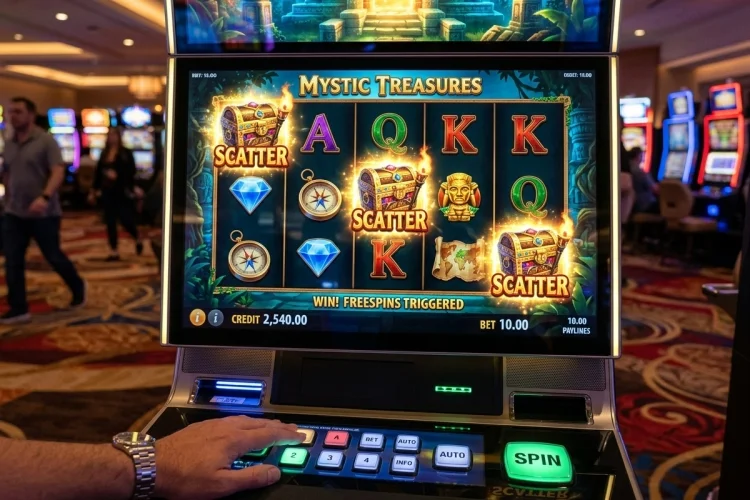
If you have played even a few modern online slots, you have probably seen a special symbol that does not behave like the regular icons on the reels. It might be marked with a bonus image, treasure chest, logo-style graphic, or another distinctive design.

Understanding What Are Scatter Symbols is useful because scatters often connect the base game to free spins, bonus rounds, multipliers, or direct payouts.

However, there is no universal scatter rule. Their exact behaviour depends on the individual slot, making the paytable and game rules especially important.

What Are Scatter Symbols in Online Slots?

Scatter symbols are special slot symbols that can activate certain payouts or features when enough of them appear during a spin.

Unlike ordinary symbols, scatters often do not need to form a traditional left-to-right combination along a payline. In many games, simply landing the required number somewhere on eligible reel positions can be enough.

That does not mean every scatter works anywhere on the grid. Some games restrict them to particular reelss or positions, while others allow them to land across the entire layout.

Their appearance also varies enormously. One slot may use a golden coin, while another uses a character, gem, logo, or object connected to the theme.

How Scatter Symbols Usually Work

The basic concept is easy to understand.

Imagine a five-reel slot where three scatter symbols are required to activate a bonus. If three qualifying scatters appear during the same spin, the feature begins according to the game’s published rules.

The symbols may not need to sit directly beside each other.

For example, a scatter could appear on reel one, another on reel three, and another on reel five. If those are valid positions under that specific game’s rules, the combination could still trigger the feature.

Pragmatic Play’s Good Luck & Good Fortune provides a real example of how rules can vary. In that game, different numbers of scatter symbols can award different quantities of free spins.

Scatter Symbols and Free Spins

Free spins are probably the feature most commonly associated with scatters.

A typical structure might require three scatters to trigger 10 free spins, while four or five could provide additional spins or another reward.

However, the numbers are entirely game-specific.

Pragmatic Play’s Candy Rush, for example, uses three to seven scatter symbols to activate a bonus game with varying numbers of free spins.

Sweet Bonanza uses another structure: four to six scatters activate its bonus feature with free spins.

These examples show why players should never assume that “three scatters equals free spins” in every slot.

Do Scatter Symbols Need to Follow Paylines?

One major difference between scatter symbols and standard paying symbols is how their positions are evaluated.

Traditional slot symbols may need to appear on specific paylines, connected reels, clusters, or predetermined winning patterns. Scatters can follow seperate rules.

Some games count qualifying scatters wherever they appear. Others limit scatters to particular reels or require a specific number of positions.

This is where the term “scatter” can sometimes be misunderstood. It describes a type of special symbol, but it does not guarantee one identical mathematical rule across every slot.

Always check the game’s Help or Paytable section rather than assuming an icon behaves like scatters from a different title.

Can Scatter Symbols Pay Cash Directly?

Yes, in some games.

A scatter does not always exist solely to unlock free spins. Developers can design scatter combinations to produce direct payouts, multipliers, jackpot features, or other rewards.

Good Luck & Good Fortune provides an example in which certain scatter combinations can provide rewards while larger combinations activate free spins.

Modern slots can take this concept even further.

Pragmatic Play’s Sugar Rush Super Scatter includes a special Super Scatter mechanic where qualifying Super Scatter symbols can provide an additional award when the bonus game is triggered.

The important lesson is simple: the word “scatter” describes the symbol category, not one universal payment formula.

What Happens to Scatters During Bonus Rounds?

Scatter symbols can continue to matter after free spins begin.

Some games allow additional scatters to retrigger free spins. Others use them to increase multipliers, add extra rounds, upgrade bonus features, or collect progress toward another reward.

In Ripe Rewards, for example, scatters during the bonus can add free spins and affect multipliers associated with the feature.

This type of mechanic makes the scatter more than a one-time trigger.

A player might first need scatters to enter the bonnus round and then need additional scatters to extend or modify it.

Again, the exact mechanic should be explained within the game’s rules.

Scatter Symbols vs Wild Symbols

Scatters and wilds are both special symbols, but their jobs are usually very different.

A wild commonly substitutes for certain regular symbols to help complete winning combinations. A scatter normally triggers or contributes toward a special feature or scatter-specific payout.

In some games, wilds cannot substitute for scatters at all.

Good Luck & Good Fortune, for instance, specifies that its wild substitutes for other symbols except the scatter.

This distinction matters because seeing a wild beside two scatters does not automatically mean you have three qualifying scatter symbols.

The individual game’s rules determine whether substitution is possible.

Why Scatter Rules Differ Between Slots

Online slot developers are free to build different mechanics around their special symbols, subject to the rules and regulatory requirements that apply to their products.

One slot might require three scatters. Another might require four. A third could have normal scatters, Super Scatters, and additional bonus symbols operating at the same time.

There can also be differences in which reels are eligible, whether scatters pay directly, and whether additional symbols retrigger the feature.

The UK Gambling Commission’s technical standards provide a useful general principle: applicable game rules should be easily available before gambling, including information explaining bonus-round requirements and how prizes or winning outcomes are determined.

That is why reading the paytable is more reliable than relying on habits from another slot.

Does Seeing Two Scatters Mean the Third Is More Likely?

No. Seeing part of a potential scatter combination does not, by itself, prove that another scatter is now more likely to appear.

In RNG-based games, outcomes are generated according to the game’s underlying mathematical system.

Great Britain’s technical standards require random outcomes to be acceptably random and prohibit adaptive or compensated behaviour in covered games.

Animations can make a near-trigger feel dramatic, especially when two scatters appear and the remaining reels spin more slowly. But visual suspense should not be confused with evidence that a bonus is “due.”

Previous misses also do not guarantee a future trigger.

How to Check Scatter Rules Before Playing

The best place to understand a scatter symbol is inside the individual game’s information panel.

Look for sections labelled Rules, Help, Paytable, Features, or How to Play.

Check how many symbols are required, which reel positions qualify, whether scatter combinations pay directly, and what happens once the feature starts.

Also check whether additional scatters can retrigger free spins.

This small amount of research prevents confusion later. A colourful symbol may look familiar, but its actual behaviour can be completely differnt from the scatter in another slot.

Scatter symbols are special slot icons that can unlock free spins, bonuses, direct prizes, multipliers, or other game features. Their positions often work differently from standard paying symbols, but there is no universal rule for every slot.

Before playing, open the paytable and check the exact scatter requirements, eligible positions, payouts, and retrigger rules so you understand how the feature actually works.

View More